Did the starting point move?
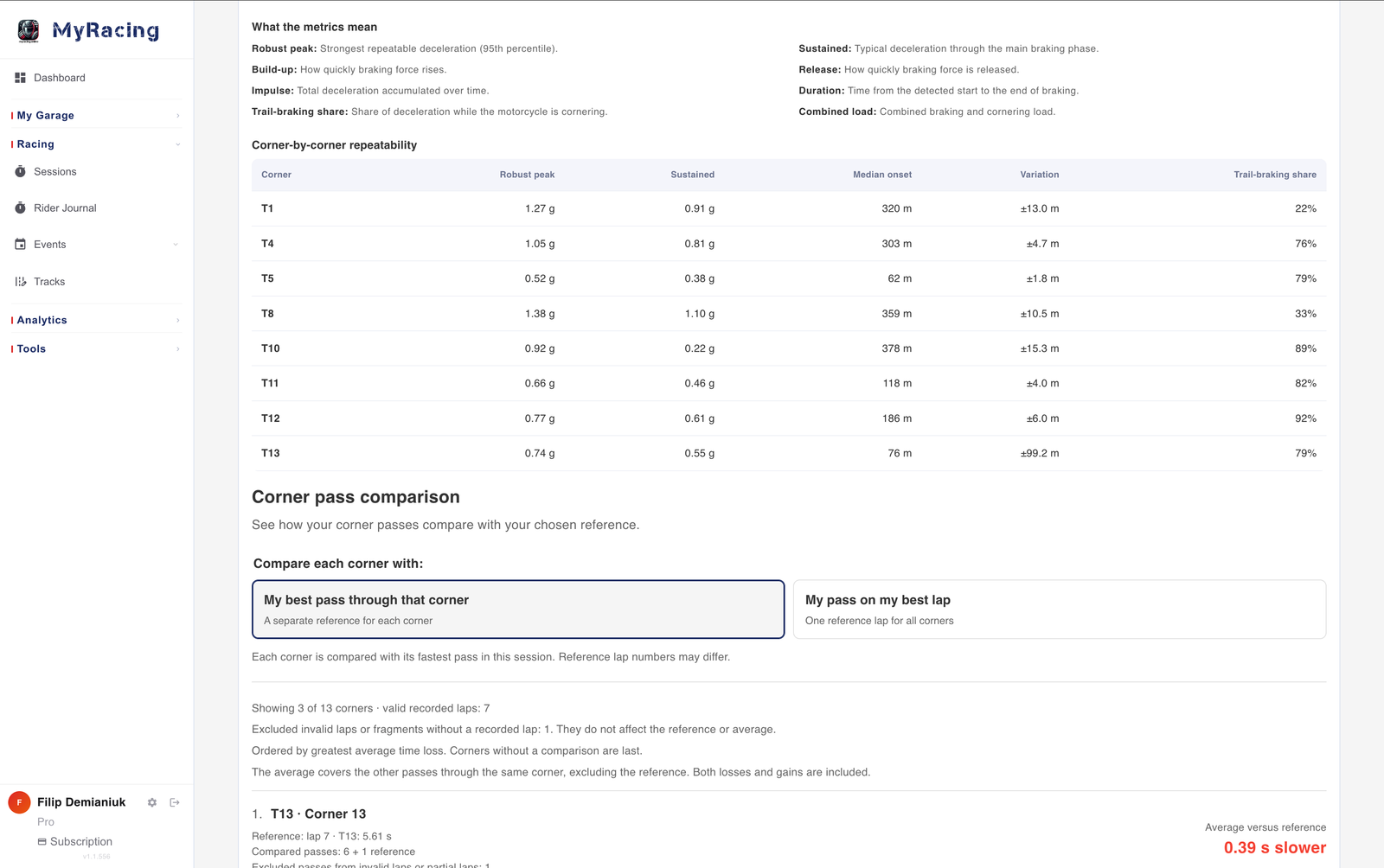
If you aim for the same reference each lap, the detected starts of slowing provide something to compare with that intention. The repeatability table shows their variation in metres at each analysed corner. A wider spread gives you a place to begin looking, without treating every braking zone as equally inconsistent.
A narrow spread is informative too. If the starts were close together, the difference you felt may be further into the approach. You can spend the review on that later phase instead of continuing to search for a large change at the beginning.
A similar peak can hide a different approach
Two slowdowns can reach a similar peak, yet one reaches it briefly and the other sustains stronger deceleration for longer. Their traces make the difference visible. Looking only at the peak would miss much of the braking phase.
The shape also shows how the deceleration built and eased away as the motorcycle began cornering. With speed and line alongside it, you can inspect the sequence that felt rushed: how the bike approached, how the slowdown developed and how that overlapped with the turn.
This gives you more to compare than a claim that one lap involved “harder braking”. The recorded movement may differ in its duration or transition even when the strongest slowdown is similar.
What the trace measures
Braking G is calculated from GPS speed and includes engine braking. It describes the motorcycle’s deceleration, including overlap with cornering, but does not measure pressure at the brake lever. Confidence information helps judge how much weight to give a small difference; a repeated pattern in reliable recordings is a firmer basis for review than a slight change in a poor trace.
Follow the approach into the turn
How you slowed also matters to what happened next. Corner analysis and lap comparison help you follow the selected attempts through the turn and onto the exit. Traffic or a deliberate experiment may explain some variation, so the circumstances of the lap belong in the interpretation. The comparison how-to covers the views and controls.
For the entry that felt hurried, you can now narrow the question. If the starting point moved, compare those approaches first. If it stayed close, examine how the slowdown developed afterwards. The review has a specific part of the riding to investigate.